
Winders are where the money is, because most fitters can’t template them
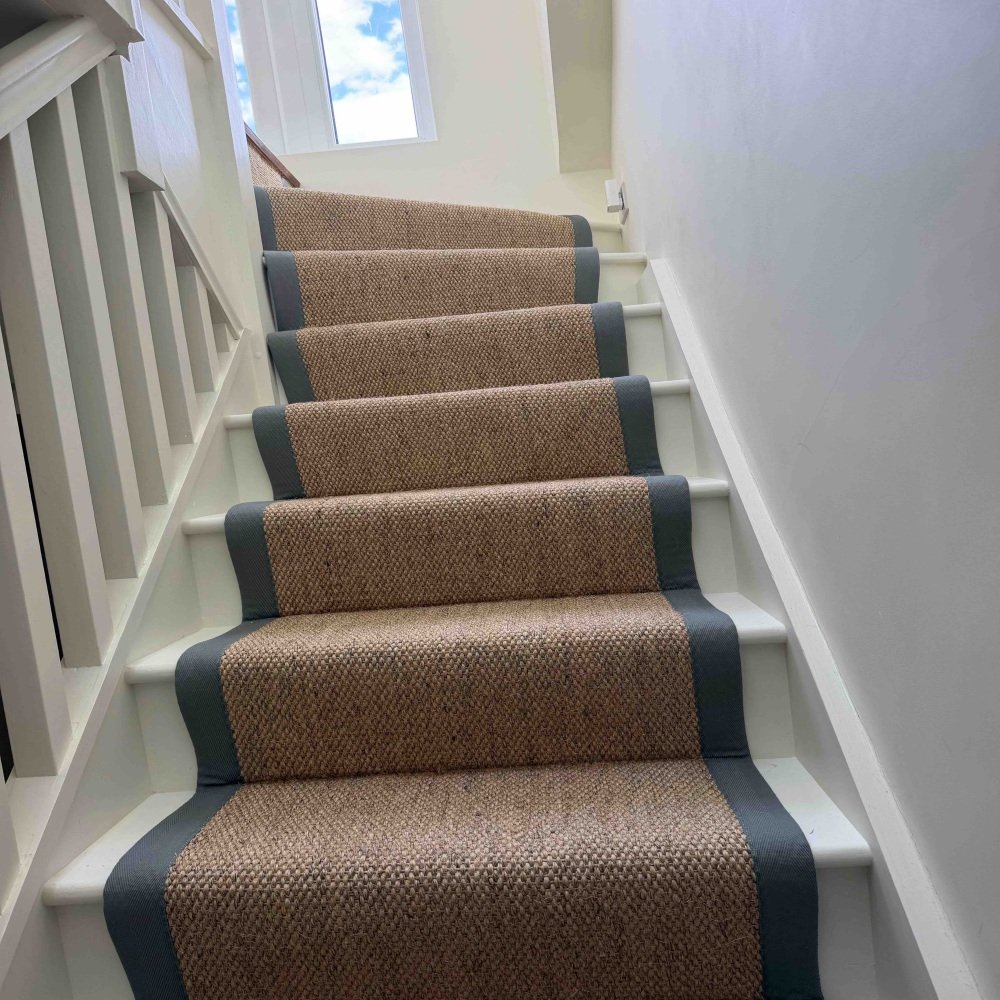
We put a sisal runner down in north-west London last week. Twenty-six steps — twenty straight, six winders, anthracite herringbone border, double-stick over ten-mil Powerlay.
The twenty straight steps are a morning’s work for anyone competent. The six winders are the reason we could take the job at all, and the reason jobs like it pay what they pay.
Ask around and you’ll find plenty of fitters who’ll do a runner on a straight flight. Ask who’ll template a double-turn staircase and cut it to shape with a border on it, and the list gets very short very quickly. That shortage is not a problem in the trade. For the fitter who can do it, it’s the whole opportunity.
The template is the job
A winder is wider at one end than the other. No two on a flight are the same. You cannot cut one from a measurement, because a measurement gives you a number and what you need is an outline.
So you attend, and you template every winding step in paper on site. Those templates go back to the workshop, the runner gets positioned and cut to them, the border is attached to the shape, and you return a week later to fit.
Everything that determines whether that runner looks made-to-measure or merely laid has already happened by the time you arrive to fit it. The fitting day is the easy day. The template day is the job.
What “accurate” actually means
The paper is the easy part. What separates a template that works from one that costs you a runner:
Fix it down properly. A template that shifts a few millimetres while you’re drawing it is a template that’s wrong, and you won’t know until the piece is cut.
Number everything, on the spot. Six winder templates look much the same on a bench a week later. Number them, mark which step, mark which way is up and which edge is the nose. Templates fitted to the wrong step is the classic way to lose a whole runner.
Mark the centre line. The border margin either side is what the customer’s eye follows all the way up the flight. If your centre wanders on a winder, the border widens on one side and everybody sees it.
Record the direction. Weave and pile have a direction. Get one winder reversed and it will catch the light differently from every other step on the staircase.
Allow for the border and the wrap. You’re not cutting to the template edge. You’re cutting to the template plus what the border takes plus what wraps the nose. Template the tread, cut the runner — they’re not the same outline.
None of that is difficult to understand. All of it is difficult to do consistently, in someone’s house, on a cold morning, on a staircase that isn’t square, six times in a row.
What work like this pays
I’ll give a guide rather than a number, because rates move and I don’t want anyone waving a blog post at a project manager two years from now.
A job of this size — twenty-six steps with six winders, templated and workshop-cut — is the sort of work that pays a fitter somewhere in the region of several hundred pounds across the two visits, with the templating visit paid separately from the fitting. What matters more than the figure is the structure:
- Templating is paid separately from fitting. Two visits, two payments. Anyone rolling them into one number is losing one of them.
- Templating carries a minimum. It has to. The van, the journey and the bench time are the same whether the staircase has two winders or six, so per-step pricing with no floor under it punishes you on every small flight — and small flights are most of them.
- Winders pay more than straight steps. Meaningfully more, not a token.
Check the current rates with whoever’s offering you the work, on the day. But if a firm is quoting you runner work without a separate templating line and a minimum on it, that tells you something about the firm.
How to get good at it
Nobody learns this from reading about it.
Practise on your own staircase first. Template it. Cut it in something cheap. Fit it. Look at what’s wrong. Do it again. You’ll learn more from one botched winder you paid for yourself than from ten you did on someone else’s stairs.
Find someone who can already do it and make yourself useful. Carry the templates. Watch where they tape, how they mark, what they write on the paper. A day alongside someone good is worth a month of guessing. Most experienced runner fitters are more willing to show you than you’d expect — the skill isn’t secret, it’s just uncommon.
Get trained properly. The Flooring Guild run carpet fitting courses including a full stair cover course, and membership gets you workshops and masterclasses alongside people who do this for a living. If you’re serious about runners, that’s a sensible place to start rather than learning it expensively on jobs.
Why bother
Because the straight-flight work is crowded and the winder work isn’t. Because a customer with a turning staircase has usually been told by two firms that it’s difficult, and is genuinely pleased to find someone who says yes. And because the last thing a good runner does is make the staircase look like the carpet was always meant to be there.
Stand at the bottom of a finished flight and look up. The border should read as one continuous line from bottom to top, round the turn, same margin either side, no wander. Get that right six times on six different shapes and you’ll never be short of work.
Cavendish deVere fit runners across London. If you template winders properly and want steady work, we’re always interested — get in touch.
 |
 |
 |
 |
 |
 |
Recent Comments